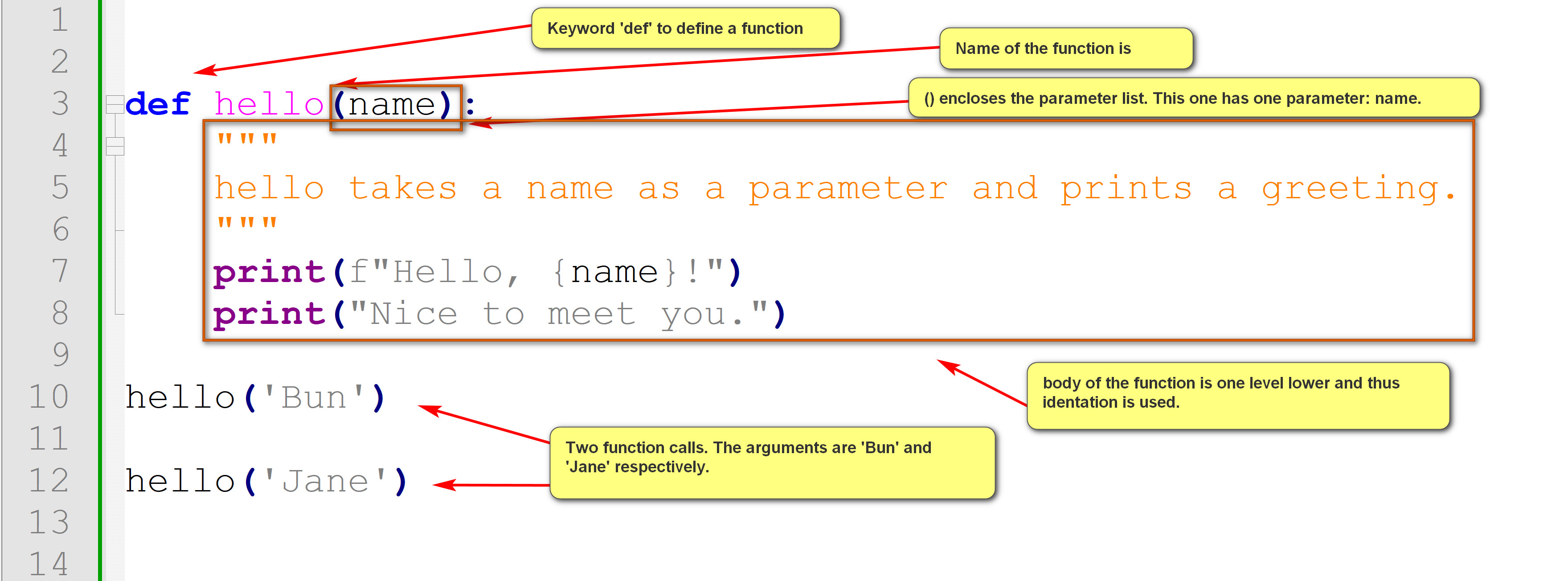
Functions
CSCI 1470
by K. Yue
1. Functions: Introduction
1.1 Mathematical Functions
Examples:
f(x) = 2 * x + 4
g(y) = y ** 2 + 1
h(x,y,z) = x + y + z
f(1) returns 6
f(3) returns 10
g(2) returns 5
g(4) returns 17
h(1,2,3) returns 6
h(f(1),g(2),f(3)+g(4)) returns 38
1.2 Python Functions
There are many advantages of using Python's functions. Some advantages include:
2. User-defined Functions
def function_name(parameters):
function_body (indented)
Example:
def area(width, length):
print(f"Area of a {width} * {length} rectangle: {width * length}")
# The print statement is an example of 'side effect': action other than the return value. Side effects should be avoided as much as possible.
area(5,6)
area(7,10)
# A better version: no side effect and use the return statement. It is also more general and useful.
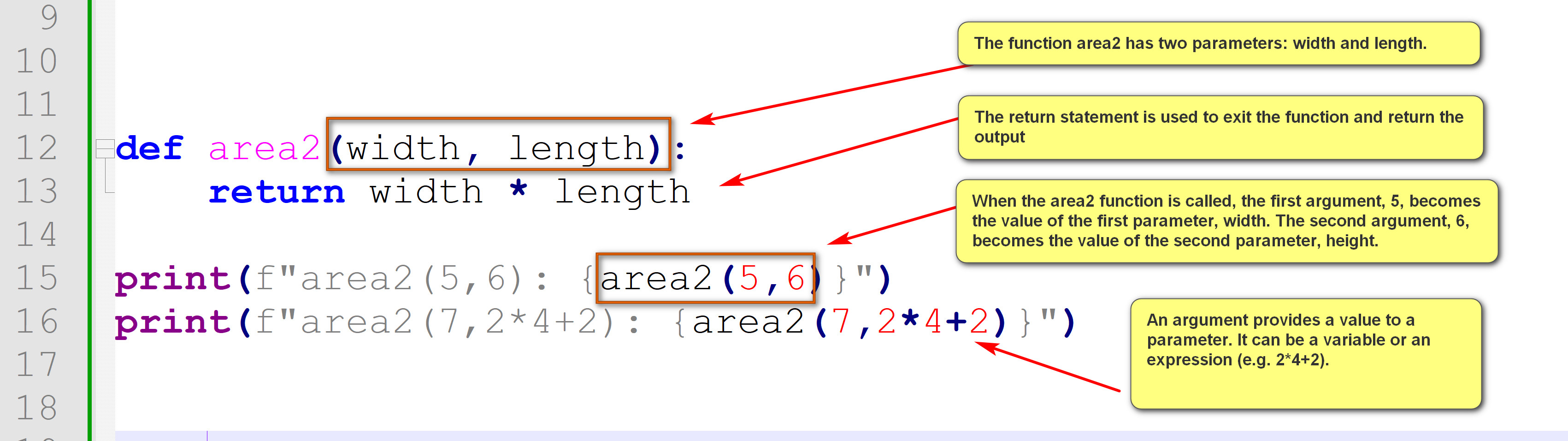
def area2(width, length):
return width * length
print(f"area2(5,6): {area2(5,6)}")
print(f"area2(7,2*4+2): {area2(7,2*4+2)}")
width_1 = 5
length_1 = 6
print(f"Area of a {width_1} * {length_1} rectangle: {area2(width_1, length_1)}")
width_2 = 7
length_2 = 10
print(f"Sum of the areas of the two rectangles: {area2(width_1, length_1) + area2(width_2, length_2)}")
def hello(name):
"""
hello takes a name as a parameter and prints a greeting.
"""
print(f"Hello, {name}!")
print("Nice to meet you.")
hello('Bun')
hello('Jane')
The following example shows some advantages of functions.
Example:
Get the names and ages of three players and display greetings.
Without using function: player_greetings_no_fun.py
# Process player 1 input and display a welcome message.
player_1_name = input("Player 1: please enter your name: ")
player_1_age = int(input("Player 1: please enter your age: "))
if player_1_age >= 18:
print(f"Hello, {player_1_name}! You are an adult.")
else:
print(f"Hello, {player_1_name}! You are a minor.")
# Process player 2 input and display a welcome message.
player_2_name = input("Player 2: please enter your name: ")
player_2_age = int(input("Player 2: please enter your age: "))
if player_2_age >= 18:
print(f"Hello, {player_2_name}! You are an adult.")
else:
print(f"Hello, {player_2_name}! You are a minor.")
# Process player 3 input and display a welcome message.
player_3_name = input("Player 3: please enter your name: ")
player_3_age = int(input("Player 3: please enter your age: "))
if player_3_age >= 18:
print(f"Hello, {player_3_name}! You are an adult.")
else:
print(f"Hello, {player_3_name}! You are a minor.")
Using two functions: player_greetings.py
def get_user_details(user):
name = input(f"{user}: please enter your name: ")
age = int(input(f"{user}: please your age: "))
return name, age
def display_greeting(name, age):
if age >= 18:
print(f"Hello, {name}! You are an adult.")
else:
print(f"Hello, {name}! You are a minor.")
# Main program
player_1_name, player_1_age = get_user_details("Player 1")
display_greeting(player_1_name, player_1_age)
player_2_name, player_2_age = get_user_details("Player 2")
display_greeting(player_2_name, player_2_age)
player_3_name, player_3_age = get_user_details("Player 3")
display_greeting(player_3_name, player_3_age)
If the way of getting input and displaying greetings are changed, and there are now four players:
def get_user_details(user):
name = input(f"{user}: please enter your name: ")
age = int(input(f"{user}: and your age: "))
return name, age
def display_greeting(name, age):
if age >= 90:
print(f"Hello, {name}! Sure want to play? :-)")
else:
print(f"Hello, {name}! Let's roll.")
# Main program
player_1_name, player_1_age = get_user_details("Player 1")
display_greeting(player_1_name, player_1_age)
player_2_name, player_2_age = get_user_details("Player 2")
display_greeting(player_2_name, player_2_age)
player_3_name, player_3_age = get_user_details("Player 3")
display_greeting(player_3_name, player_3_age)
player_4_name, player_4_age = get_user_details("Player 4")
display_greeting(player_4_name, player_4_age)
2.1 Function parameters and arguments
2.1.1 Positional and named parameters
Example:
# positional parameters
def add_two(a,b):
return a+b
print("""
def add_two(a=1,b=0):
return a+b
""")
print(f"add_two(1,4): {add_two(1,4)}")
print(f"add_two(a=1,b=4): {add_two(a=1,b=4)}")
print(f"add_two(-1,40): {add_two(-1,40)}")
def add_two_with_default(a=1,b=2):
return a+b
print("""
def add_two_with_default(a=1,b=2):
return a+b
""")
print(f"add_two_with_default(1,4): {add_two_with_default(1,4)}")
print(f"add_two_with_default(a=1,b=4): {add_two_with_default(a=1,b=4)}")
print(f"add_two_with_default(-1,40): {add_two_with_default(-1,40)}")
print(f"add_two_with_default(8): {add_two_with_default(8)}")
print(f"add_two_with_default(b=1): {add_two_with_default(b=1)}")
print(f"add_two_with_default(): {add_two_with_default()}")
# Positional parameters and keyworded (named) parameters.
# A parameter has a position and a name.
def introduce(name, age):
print(f"My name is {name} and I am {age} years old.")
return 'done'
print("""
def introduce(name, age):
print(f"My name is {name} and I am {age} years old.")
return 'done'
""")
print(f"introduce('Jane', 19): {introduce('Jane', 19)}")
print(f"introduce(19,'Jane'): {introduce(19,'Jane')}")
print(f"introduce(name='Jane', age=19): {introduce(name='Jane', age=19)}")
print(f"introduce(age=19,name='Jane'): {introduce(age=19,name='Jane')}")
Example:
# arbitrary numbers of arguments.
def add(*args):
return sum(args)
print("""
def add(*args):
return sum(args)
""")
print(f"add(1,2,3,4,5): {add(1,2,3,4,5)}")
print(f"add(10,2,3,4,5,6,7): {add(10,2,3,4,5,6,7)}")
def multiplied_sum(*numbers, multiplier=1):
total_sum = sum(numbers)
return total_sum * multiplier
print("""
def multiplied_sum(*numbers, multiplier=1):
total_sum = sum(numbers)
return total_sum * multiplier
""")
print(f"multiplied_sum(1,2,3,4,multiplier=5): {multiplied_sum(1,2,3,4,multiplier=5)}")
print(f"multiplied_sum(1,2,3,4,5): {multiplied_sum(1,2,3,4,5)}")
def area(*, width, length):
return width * length
print("""
def area(*, width, length):
return width * length
""")
print(f"area(width=2,length=3): {area(width=2,length=3)}")
print(
"""
print(f"area(2,3): {area(2,3)}")
TypeError: area() takes 0 positional arguments but 2 were given
"""
)
2.2 Specifying types of functions
Example:
def sum(a: int, b: int) -> int:
return a+b
#
def divide(a: int, b: int) -> in | None:
if b == 0:
return None
else:
return a+b
2.3 Functions are objects
Example:
fun_obj_1.py: functions are callable objects.
def hello(name):
print(f"hello, {name}. Nice to see you.")
def bye(name):
print(f"Bye, {name}. See you next time.")
my_func = hello
my_func('Bun')
my_func = bye
my_func('Bun')
greetings = {
"hello": hello,
"bye": bye
}
greetings["hello"]("Jane")
greetings["bye"]("Jane")
3. Python built-in functions and imported functions
3.1 Built-in functions
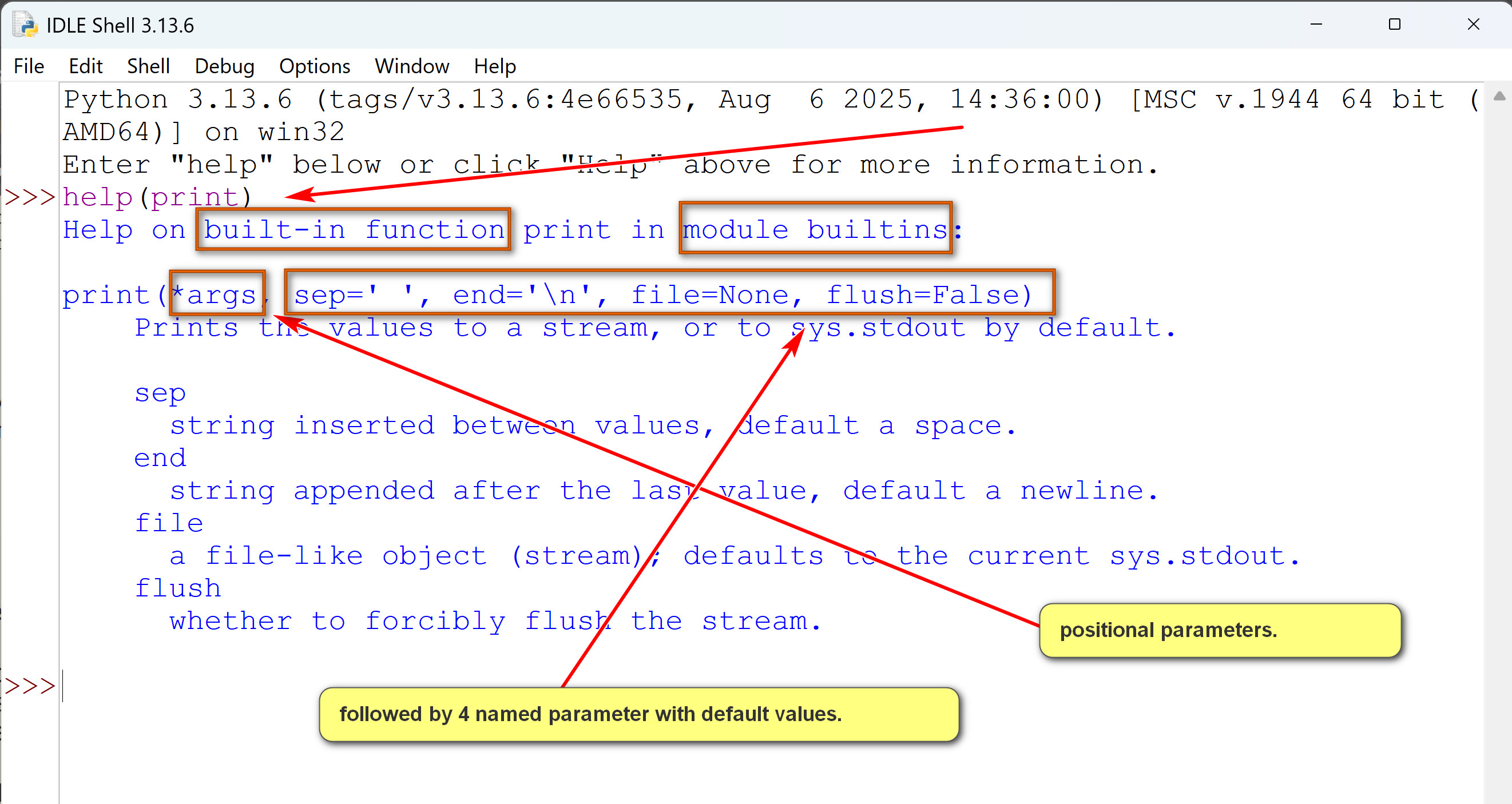
To understand built-in functions:
Example:
Some categories of built-in functions:
3.2 Imported functions
Example:
import math
from random import randint
# imported functions of the math module are called by full names: e.g., math.sqrt()
# imported function randint of the random module is called directly.
print(f"math.sqrt(64): {math.sqrt(64)}")
print(f"math.pi: {math.pi}")
print(f"math.sin(1): {math.sin(1)}")
print(f"math.gcd(24,36,126): {math.gcd(24,36,126)}")
print(f"math.lcm(24,36,126): {math.lcm(24,36,126)}")
print(f"randint(1,10): {randint(1,10)}")
print(f"randint(1,10): {randint(1,10)}")
print(f"randint(1,10): {randint(1,10)}")
print(f"randint(1,10): {randint(1,10)}")
print(f"randint(1,10): {randint(1,10)}")